
 เครื่องยนต์
แจ็คสโตน Cat6 และ Cat6a เหมือนกันหรือไม่ ต้องการทราบคำตอบ?
2025-12-15
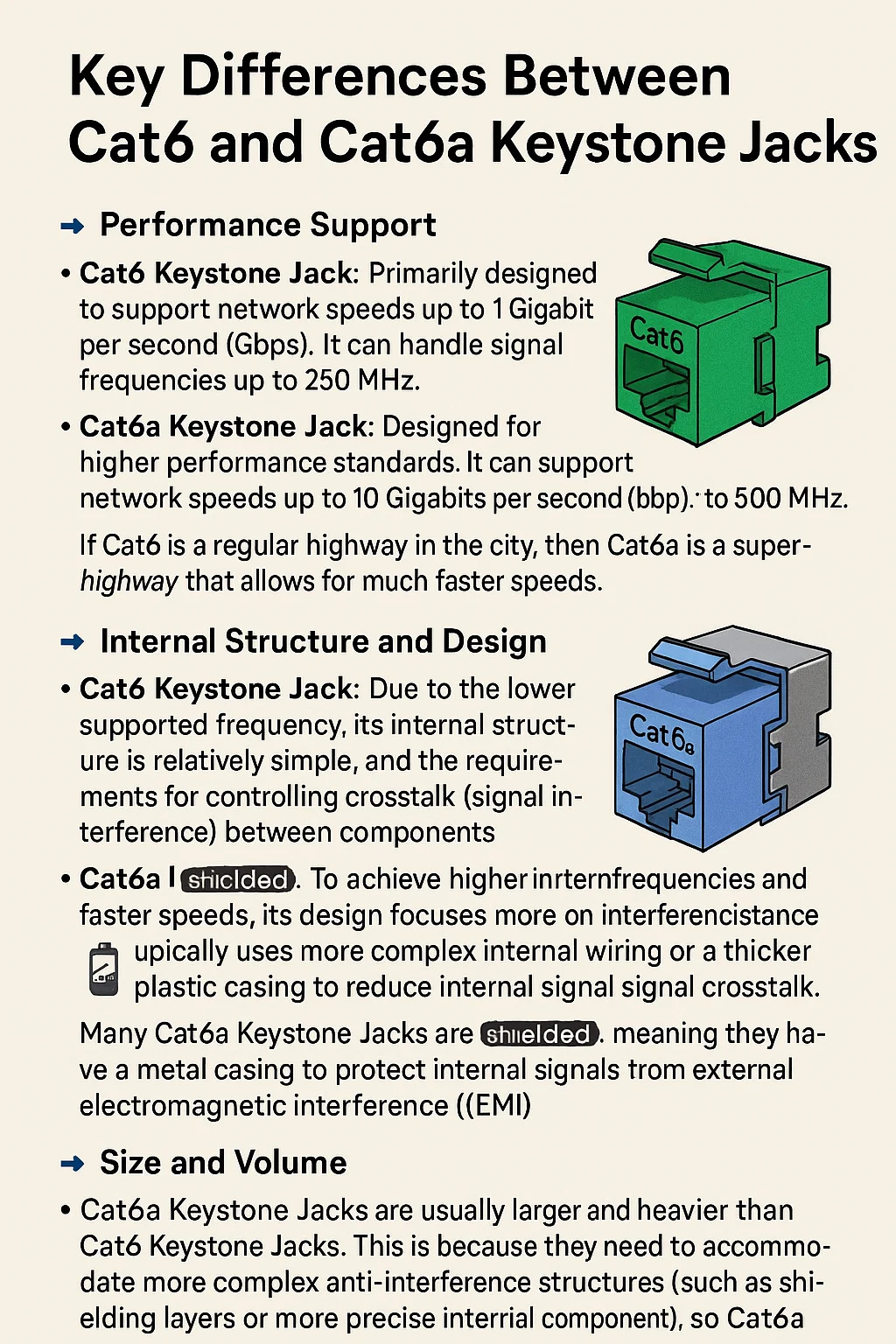
Key Differences Between Cat6 and Cat6a Keystone Jacks
▸ Performance Support
• Cat6 Keystone Jack: Primarily designed to support network speeds up to 1 Gigabit per second (Gbps). It can handle signal frequencies up to 250 MHz.
• Cat6a Keystone Jack : Designed for higher performance standards. It can support network speeds up to 10 Gigabits per second (Gbps) and increases signal frequency handling capabilities to 500 MHz.
• Simple Analogy: If Cat6 is a regular highway in the city, then Cat6a is a superhighway that allows for much faster speeds.
▸ Internal Structure and Design
• Cat6 Keystone Jack : Due to the lower supported frequency, its internal structure is relatively simple, and the requirements for controlling crosstalk (signal interference) between components are relatively less stringent.
• Cat6a Keystone Jack: To achieve higher frequencies and faster speeds, its design focuses more on interference resistance.
It typically uses more complex internal wiring or a thicker plastic casing to reduce internal signal crosstalk.
Many Cat6a Keystone Jacks are **shielded**, meaning they have a metal casing to protect internal signals from external electromagnetic interference (EMI).
▸ Size and Volume
• Cat6a Keystone Jacks are usually **larger and heavier** than Cat6 Keystone Jacks.
• This is because they need to accommodate more complex anti-interference structures (such as shielding layers or more precise internal components), so Cat6a modules may occupy more space during installation.
ร่วมมือกับ Puxin?
ติดต่อเราเพื่อดูว่าผลิตภัณฑ์ของเราสามารถเปลี่ยนแปลงธุรกิจของคุณได้อย่างไรและ
นำไปสู่ระดับต่อไป

บริษัท Ningbo Puxin Electronic Technology Co., Ltd. เป็นซัพพลายเออร์มืออาชีพด้านการวิจัยและพัฒนาและการผลิตผลิตภัณฑ์ด้านวิศวกรรมไฟฟ้าและสายไฟแบบบูรณาการ.
-

No.43 of Xiaotuanpu Road, Guanhaiwei Town, Cixi Ningbo City, เจ้อเจียง, จีน
-

-

+86-15924366333
-



ลิขสิทธิ์© Ningbo Puxin Electronic Technology Co., Ltd.
